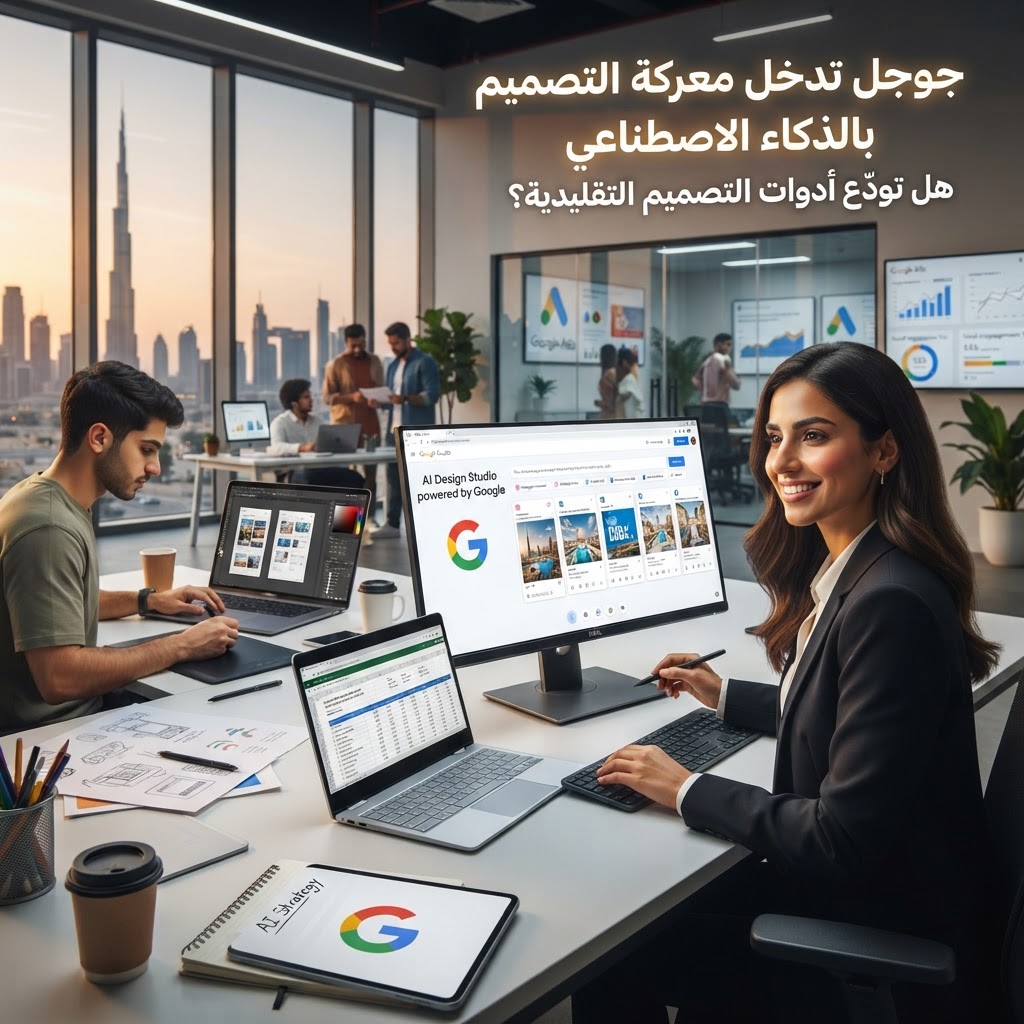
Google's new AI design tool is challenging Canva and Adobe. Here's what it means for marketers in the Gulf and Arab region.
The Design Game Just Changed — Are Arab Marketers Ready?
For years, the creative software market has been dominated by two giants: Adobe for professionals and Canva for everyone else. But Google has just thrown a serious punch into this space with Google Pics, an AI-first design tool that flips the entire creative workflow on its head. Instead of dragging and dropping elements, you simply describe what you want — and the AI builds it for you.
As someone who has spent over 13 years working with brands across the Gulf and Arab world, I can tell you this is not just another tech release. This is a fundamental shift in how marketing teams, small business owners, and content creators will produce visual content. And the implications for our region are massive.
1. What Exactly Is Google Pics and Why Does It Matter?
Google Pics is Google's direct answer to the growing dominance of Canva and Adobe Express. The core concept is simple but revolutionary: you prompt, the AI designs. No templates to scroll through. No font pairing headaches. No layer management.
You type something like: "Create a social media post for an Eid al-Fitr sale with warm gold tones and Arabic calligraphy feel" — and Google Pics generates it for you in seconds.
This is a game-changer because it removes the single biggest barrier to quality content creation: design skill.
2. The Gulf Market Context: Why This Hits Differently Here
In the Arab world, and especially across the GCC — Saudi Arabia, UAE, Kuwait, Qatar, Bahrain, and Oman — the demand for bilingual and culturally-relevant visual content is enormous. Yet, most AI design tools have historically struggled with:
- Arabic typography and right-to-left layouts
- Culturally appropriate imagery (modest fashion, Islamic geometric patterns, etc.)
- Local holidays and seasonal campaigns (Ramadan, National Day, Eid, Vision 2030 themes)
If Google Pics can handle Arabic prompts and generate culturally-aware designs, it will instantly outperform every existing tool for our market. Imagine a small business owner in Riyadh or a social media manager in Dubai being able to type in Arabic and get a print-ready design within seconds. That's not the future — that's the imminent present.
3. Practical Use Cases for Arab Marketers and Businesses
Let me break down where this tool could have the most immediate impact in our region:
E-commerce Brands in Saudi Arabia and UAE
Platforms like Noon, Namshi, and countless Instagram-based boutiques produce hundreds of product visuals per month. With an AI prompt-based tool, a one-person operation in Jeddah can now produce the same quality visuals as a brand with a full design team in Dubai.
Real Estate Marketing in Dubai and Riyadh
Real estate is one of the most visually-competitive sectors in the Gulf. Agencies spend thousands on design for off-plan project launches. A prompt like "Luxury waterfront apartment launch poster, Arabic and English, Dubai skyline background, premium gold and navy palette" could replace hours of design work.
From Talabat promotions to local restaurant chains in Amman or Cairo, food businesses need constant fresh visuals for social media. AI-generated designs mean faster campaign cycles and lower costs.
Ramadan and National Day Campaigns
Every year, brands across the Arab world scramble to produce themed content for Ramadan, Saudi National Day, UAE National Day, and Kuwait National Day. A prompt-based tool that understands cultural context could transform the speed and scale of these campaigns.
4. How Google Pics Compares to Canva and Adobe for Our Market
| Feature | Google Pics | Canva | Adobe Express |
|---|---|---|---|
| AI Prompt Design | ✅ Core Feature | ⚠️ Limited | ⚠️ Limited |
| Arabic Language Support | 🔜 Expected | ✅ Available | ✅ Available |
| Cultural Templates | 🔜 TBD | ✅ Some | ⚠️ Limited |
| Ease of Use | ✅ Very High | ✅ High | ⚠️ Moderate |
| Integration with Google Workspace | ✅ Native | ⚠️ Third-party | ❌ No |
| Price | 🔜 TBD | Freemium | Freemium |
The key advantage Google brings is ecosystem integration. For teams already using Google Workspace — which is extremely common among startups and SMEs across the Gulf — having an AI design tool built directly into their workflow is a massive productivity win.
Now, as exciting as this all sounds, I want to give you an honest professional perspective. There are real risks that marketers in our region need to watch:
- Brand consistency can suffer if prompts aren't carefully crafted with brand guidelines in mind.
- Cultural nuance — AI may still miss subtle cultural sensitivities specific to different Arab countries. What works for a UAE audience may not resonate in Egypt or Morocco.
- Generic output — If every brand uses the same AI tool with similar prompts, we risk a homogenization of visual content across social media feeds.
- Over-dependency — Teams that stop developing in-house creative thinking will eventually lose their brand voice.
The solution? Use AI as a starting point, not a final product. Train your team to write specific, brand-aligned prompts and always review output through a cultural lens.
6. What Arab Marketing Teams Should Do Right Now
Here's my practical advice for brands and marketers in the Gulf and broader Arab world:
- Start experimenting immediately — Don't wait for the tool to be perfect. Early adopters will build a competitive advantage.
- Develop a prompt library — Create a set of brand-specific, culturally-informed prompts that your team can reuse and refine.
- Audit your current design workflow — Identify which repetitive design tasks could be automated with AI tools.
- Invest in prompt engineering training — Yes, this is now a real skill. The quality of your AI output depends entirely on the quality of your prompt.
- Test Arabic language prompts — As soon as Google Pics becomes available in our region, immediately test it in Arabic and report back to your team on what works.
- Don't fire your designers — Seriously. Redirect them toward higher-level creative strategy and brand storytelling that AI cannot replicate.
Conclusion: The Prompt Is the New Pencil
Google Pics represents more than just a new tool — it signals a complete paradigm shift in how visual content is created. In a region like ours, where visual identity is deeply tied to culture, language, and tradition, this technology carries both enormous opportunity and real responsibility.
The brands that win in this new era won't be the ones with the biggest design budgets. They'll be the ones who learn to communicate their vision most effectively to AI — and who never lose sight of the human touch that makes content truly resonate.
So here's my challenge to you: Before the end of this week, try one AI design tool — whether it's Google Pics, Canva's AI features, or Adobe Firefly — and create one piece of content for your brand. Experiment. Fail. Iterate. That's how you stay ahead.
The creative revolution is here. Make sure you're leading it, not chasing it.
هل أعجبك المقال؟
احجز استشارتك معي للحصول على خطة تسويق رقمي مخصصة لعملك
احجز استشارة الآن