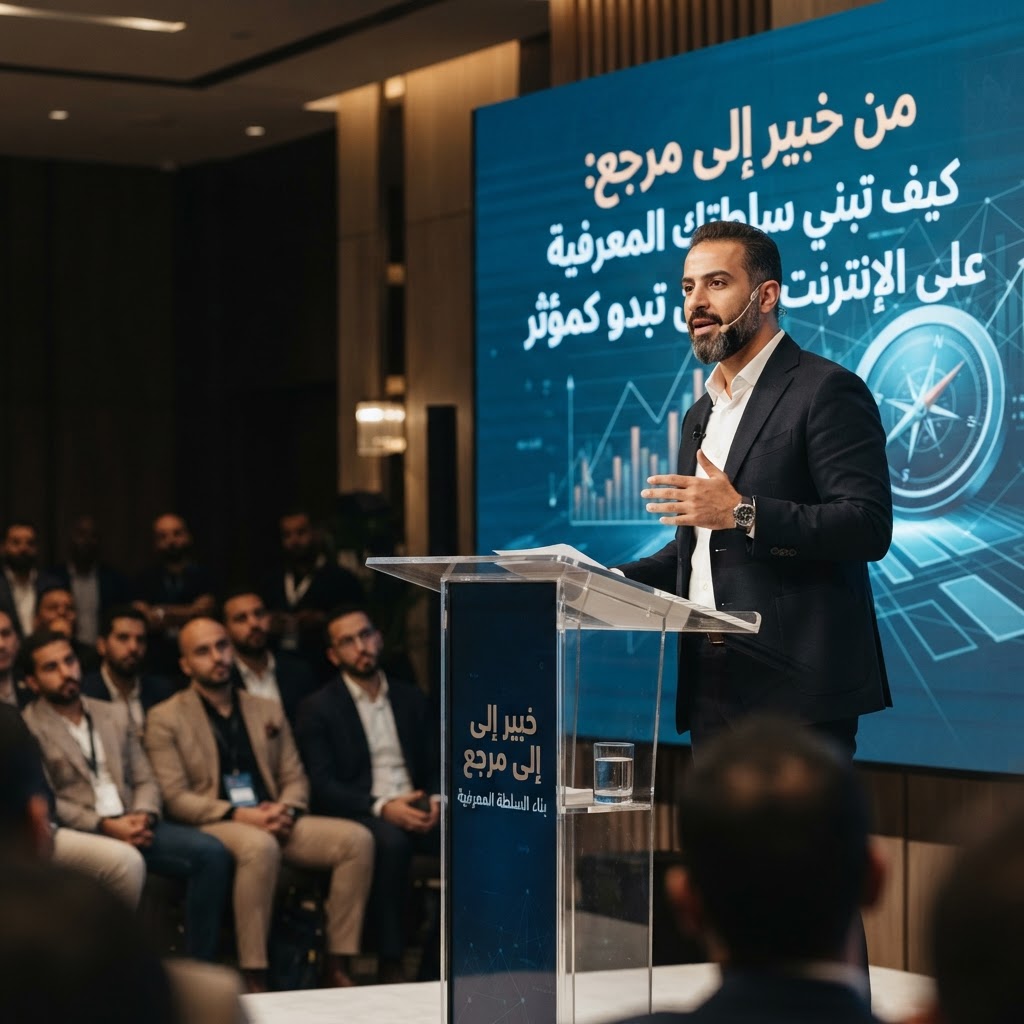
Stop trying to be an influencer. Here's how real experts build lasting digital credibility in the Gulf and beyond.
The Problem with Experts Online
Here's a paradox I see constantly across the Gulf region: some of the most brilliant minds — seasoned consultants, university professors, specialized engineers, and policy advisors — have virtually no digital presence. Meanwhile, someone with a ring light and a trending audio clip has hundreds of thousands of followers.
But here's what matters more: when a company in Riyadh needs a supply chain consultant, or a government body in Abu Dhabi needs an education reform advisor, they don't search TikTok. They search LinkedIn. They ask peers. They look for published thought leadership.
Building digital authority is not about becoming an influencer. It's about making sure that when the right people are looking for your expertise, they find you — and immediately trust what they find.
1. Understand the Difference: Personal Brand vs. Knowledge Authority
A personal brand is about visibility and personality. A knowledge authority is about credibility and depth.
Influencers build personal brands. Experts build knowledge authority.
The distinction matters practically:
- A personal brand asks: How do I get more followers?
- A knowledge authority asks: How do I become the go-to reference in my field?
Dr. Khaled Al-Jaber, a hypothetical Kuwaiti economist, doesn't need 50,000 Instagram followers. He needs his analysis to be cited in Al-Arabiya, shared in WhatsApp groups of CFOs, and referenced in government briefings. That's digital authority.
Action step: Define your audience not by size, but by specificity. Who are the 500 decision-makers who need to know your name?
Stop chasing every platform. Experts need to be strategic.
LinkedIn: Your Non-Negotiable Home Base
In the Gulf, LinkedIn has become the primary professional discovery engine. Saudi Arabia and the UAE consistently rank among the highest LinkedIn engagement rates per capita in the MENA region. If you're a consultant or academic and you're not active here, you are invisible to your most valuable audience.
What to post:
- Short analytical commentary on industry news (150–300 words)
- Lessons learned from real consulting engagements (anonymized)
- Contrarian takes backed by data
Substack or a Professional Blog
Long-form written content is how you demonstrate depth. A professor at King Abdulaziz University writing a monthly newsletter on urban planning trends in Saudi cities builds a searchable archive of expertise over time. Google remembers everything.
YouTube or Podcast (Optional but Powerful)
If your expertise translates well to explanation — think legal consultants, financial advisors, or medical specialists — a structured video series positions you as an educator, not a performer. Keep it professional, not produced like entertainment.
3. Create Content That Demonstrates Expertise, Not Just Opinion
Anyone can have an opinion. Experts provide frameworks, data, and structured thinking.
Here's a simple content formula I recommend to my clients:
The Expert Post Formula:
- Start with a counterintuitive observation or question
- Provide context using data or a real case
- Offer a framework or structured analysis
- End with a clear implication or recommendation
Gulf-specific example: A Dubai-based HR consultant could write: "Why 70% of Emiratization programs fail in the first year — and the 3 structural reasons behind it." That's not influencer content. That's thought leadership that gets shared in boardrooms.
4. Build Credibility Signals — The Digital Proof Points
Authority needs proof. Here are the credibility signals that matter most:
- Publications and citations: Even LinkedIn articles get indexed. Write them.
- Media appearances: Getting quoted in Arabian Business, Forbes Middle East, or Asharq Al-Awsat is worth more than 10,000 followers.
- Speaking engagements: Mention them publicly. Share slides. Post a key insight from your talk.
- Endorsements from peers, not fans: A recommendation from a respected industry figure on LinkedIn is a trust multiplier.
- Clear, specific positioning: Your LinkedIn headline should not say "Consultant | Speaker | Entrepreneur." It should say something like: "Supply Chain Resilience Advisor for GCC Manufacturing Firms."
5. Consistency Over Virality
The biggest mistake I see experts make is waiting until they have something "big" to share. Authority is built through consistent, modest contributions over time — not viral moments.
Commit to a realistic publishing cadence:
- LinkedIn: 2–3 posts per week
- Newsletter: Once or twice a month
- Long-form article or case study: Once a quarter
A Jordanian cybersecurity consultant who posts one sharp LinkedIn insight every Tuesday for two years will be more discoverable and more trusted than someone who posts 20 times in January and disappears.
Digital authority is also built in the comments section — not just your own posts.
When a major regional policy announcement drops, jump into the conversation on LinkedIn with a substantive comment. When a peer publishes research, engage with a real question or a respectful addition. This positions you as part of the intellectual conversation in your field.
Avoid the trap of self-promotional engagement: "Great post! I help companies with this — DM me." That destroys credibility instantly.
Conclusion: Your Expertise Deserves to Be Found
The Gulf region is experiencing a transformation — Vision 2030 in Saudi Arabia, UAE centennial goals, economic diversification across Kuwait, Bahrain, and Oman. This creates enormous demand for genuine expertise. But that expertise needs to be visible and accessible to create real impact.
You don't need to dance on Reels or chase trending hashtags. You need to show up consistently in the right spaces, speak with precision and depth, and make it easy for the right people to find you and trust you.
Start today with one small action: Update your LinkedIn headline to reflect your specific expertise. Not your job title — your value proposition as a knowledge authority.
That's how the shift begins. Not with a viral post, but with a deliberate decision to own your expertise online.
Bhaa Al-Ahmad is a digital marketing strategist with 13+ years of experience helping professionals and organizations build meaningful digital presence across the Arab world.
هل أعجبك المقال؟
احجز استشارتك معي للحصول على خطة تسويق رقمي مخصصة لعملك
احجز استشارة الآن